Sanatorium Ingest Photobox: measuring food waste with edge AI
A multi-sensor capture unit for food-waste analysis, built in the aws Food Explore project: stereo 3D, weight and time-of-flight sensing with AI that runs locally.
Care and hospital kitchens throw away a surprising share of what they cook, and nobody can say exactly how much, or of what. The Sanatorium Ingest Photobox is our answer to the measurement problem: a self-contained unit that looks at a plate or tray, weighs it, and lets an AI model work out what was left. The project is funded by aws Food Explore (project P2504754).
Why sensor fusion
A photo alone tells you what is on the plate, but not how much. A scale alone tells you how much, but not what. Combining the two, and adding depth, turns guesses into numbers.
Simplicity is prerequisite for reliability.
— Edsger W. Dijkstra, EWD498
How it fits together
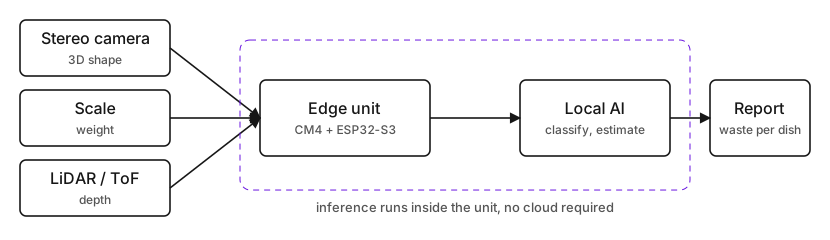
The Photobox is an edge-AI capture unit. All sensing and inference happen inside the box.
| Sensing | Typical component | Contributes |
|---|---|---|
| 3D / stereo capture | Camera pair | Shape and volume of the food |
| Weight | Precision scale (KERN class) | Mass before and after |
| Depth and distance | LiDAR, time-of-flight | Cross-check of volume and position |
| Compute and I/O | Raspberry Pi Compute Module 4, ESP32-S3 | Capture, control and inference |
A look at the numbers
The core of the analysis is simple arithmetic on fused measurements. This sketch shows the idea; the real pipeline works on 3D data and per-dish models.
def food_waste_g(tray_before_g: float, tray_after_g: float, tray_empty_g: float) -> float:
    """Waste = what is still on the tray after the meal."""
    return max(0.0, tray_after_g - tray_empty_g)

def waste_share(before_g: float, after_g: float, empty_g: float) -> float:
    served = before_g - empty_g
    return food_waste_g(before_g, after_g, empty_g) / served if served > 0 else 0.0
Names such as waste_share() are styled inline as well.
What we are working on
- Reliable volume estimation from stereo and depth data.
- Models that are small enough for the edge and still tell dishes apart.
- A capture routine that works in a busy kitchen, not only on the bench.
Food Explore is part of our wider work on edge AI and sensor fusion.